The Pedestal Lecture
One Oregon KOA reminded me that electric towing is not just a range problem. It is a permission problem.

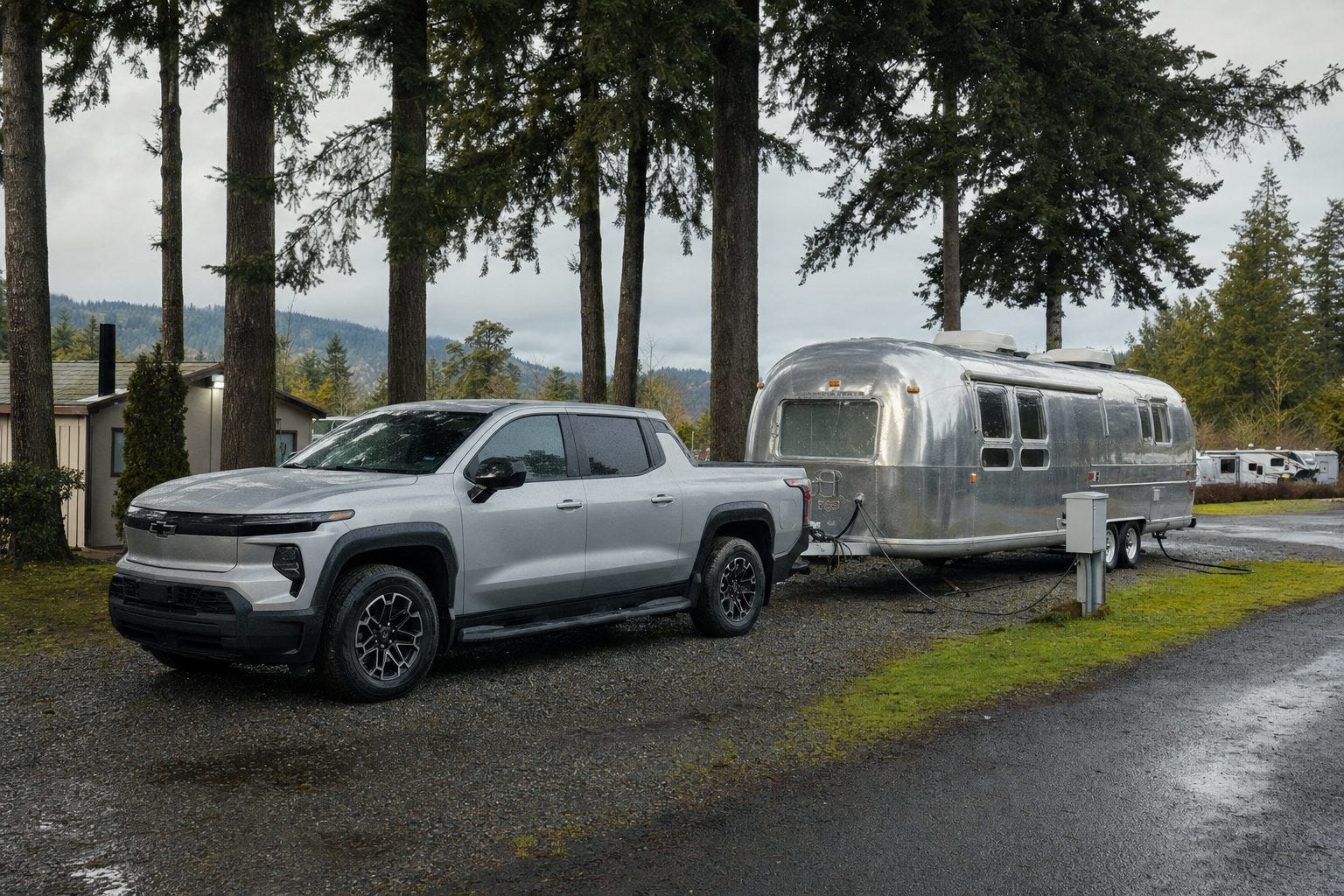
By the time I reached Sutherlin, Oregon, I already knew not to plug the truck into the campground pedestal.
This detail matters because the campground did not know that I knew.
It was a one-night stop at the Sutherlin / Umpqua Valley KOA Holiday in early May 2026, the kind of overnight that exists because the map requires it. Not a destination. Not a chapter with fireworks. Just a practical pause between longer pieces of road. Pull in, level enough, connect enough, sleep enough, leave.
I had been towing with the Silverado EV long enough by then to understand the new etiquette. Campground pedestals are not public fast chargers. A 30-amp or 50-amp RV pedestal is there to run the trailer, not refill a truck battery that can pull serious power for serious time. Even if the math technically works in some situations, the social and electrical math is different. Campgrounds are not built for every site to become a charging depot.
So I was not planning to plug in the truck.
Then came the warning.
My note from that stop is short: “Scolded me to warn me to not plug in the EV to the campground pedestal even though I hadn't planned on it. Rude.”
That is the whole comedy of it. I arrived with the correct behavior already loaded, and still got the lecture.
Electric towing changes the way people look at you.
With a diesel, assumptions are familiar. Maybe people have opinions about noise, smoke, idling, or truck size, but the category is understood. A big truck tows a trailer. It goes to fuel stations. Everyone knows the ritual.
With an EV pickup towing a vintage Airstream, the category is not settled yet. People see the truck and start doing math in their heads, often without enough numbers. Where do you charge that thing? Can it really tow? How far does it go? Are you going to use my electricity? Is this going to become a problem?
Sometimes the questions are curious. Sometimes they are skeptical. Sometimes they arrive wearing the uniform of campground policy.
I do not blame campgrounds for being cautious. Honestly, they probably should be. Electrical systems in older parks can already have enough drama without adding several thousand pounds of battery-hungry pickup to the nightly load. The pedestal is part of the RV site, not a universal energy buffet. If everyone with an EV tow vehicle treated it like one, the campground would have a real problem.
But there is a difference between a clear policy and a preemptive scolding.
That difference is where the story lives.
The Oregon stop reminded me that the hard part of electric towing is not only range, chargers, weather, speed, elevation, or trailer drag. Those are engineering problems. Annoying ones, yes, but at least they are measurable. You can plan around kilowatt-hours. You can watch consumption. You can choose chargers. You can slow down. You can build buffer back into the day.
Permission is stranger.
Permission lives in other people’s assumptions. It lives in campground rules that may or may not have been written with modern EV trucks in mind. It lives in whether a host sees the rig as normal, suspicious, clever, annoying, or a future support ticket. It lives in the sentence before you have had a chance to explain yourself.
I felt that in Sutherlin.
The site itself was fine. Oregon has a way of making even practical roadside stops look better than they have any right to look. The light is softer. The trees do some public relations work. The Airstream looks good almost anywhere with greenery behind it, and a silver truck beside polished aluminum has a certain accidental coherence.
But the interaction colored the stop.
That happens on the road. A place is not just its hookups, rate, trees, weather, or proximity to the interstate. A place is also how you are received. One good conversation can redeem an otherwise ordinary campground. One unnecessary lecture can flatten a perfectly adequate overnight into a note you remember for the wrong reason.
The funny part is that I agree with the underlying rule.
I do not think RV parks owe EV owners free vehicle charging from site pedestals. I do not think “I paid for a campsite” automatically means “I can pull whatever load I want for whatever purpose I want.” The infrastructure was designed around the trailer. If the campground wants to allow EV charging, great — price it, meter it, designate it, support it. If not, say so clearly.
What rubbed wrong was being treated like the problem before I had done the problem.
That may be the next phase of electric towing: not proving the truck can tow, but proving the driver understands the system. The Silverado EV is capable. The Airstream is towable. The route can be planned. But every campground, charger, and overnight stop still sits inside a cultural transition. People are learning what these rigs mean in real time.
So am I.
The old diesel life had its own compromises. Fuel stops were easier to understand but not always easier to execute. Noise was part of the package. Maintenance had its own calendar. The electric truck changed the map, but it did not remove friction. It just moved some of the friction into new places.
Sutherlin was one of those places.
A one-night stop. A silver EV truck. A tandem-axle Airstream. A campground pedestal I was not going to use for the truck. A warning I did not need but apparently had to receive anyway.
No disaster. No villain. Just a small social bug report from the road.
That is a lot of full-time travel, honestly. Not dramatic failures. Not grand triumphs. Just little moments where the system shows you where the edges are.
In Oregon, one of the edges was not electrical.
It was conversational.
Photo note: Some images in this post may be AI-generated or AI-assisted when I did not take photos directly related to this story. When that happens, the images are meant to illustrate the scene and are based on my actual truck and Airstream.